Secondary traumatic stress and burnout, part 1

Earlier this evening I saw a social media post from a student I had several years ago. She was writing about transitioning into a new line of work because of experiencing burnout in her social work career. I have kept up with this student over the years and I know her to be committed to service, and to be someone who works with integrity. I am sorry she is leaving social work practice in the traditional sense, but I know she will always be a social worker in the sense of looking at the world in systems, in terms of problem solving, etc. I am sorry she is leaving the profession, but I understand it.

Burnout is real, and it is brutal.

Photo by Volkan Olmez on Unsplash

I have a BSW and, sadly, no professor in my undergraduate program taught me about the dangers of burnout. I don’t remember the discussion of it in my MSW program either. Maybe those topics weren’t talked about then, maybe they were discussed but not by my professors. Maybe it was discussed in practice class the day I was late because of talking to a boy in the hallway and the professor locked the door on me.

Another topic I didn’t hear about was secondary traumatic stress (STS), but that’s because we (as a profession) weren’t aware of this concept in any significant way at that time.

Secondary traumatic stress is real, and it is brutal.

One of the things I try to help my students understand is the difference between burnout and secondary traumatic stress. There is negative impact of both, certainly, but solutions differ somewhat. I typically explore this in the context of child welfare class, and somewhat in the macro practice class when we are talking about how organizational culture shapes our practice but it would also fit in a micro or mezzo practice class.

This podcast episode is useful for understanding STS, and told from the perspective of child welfare professionals with long histories in child welfare work: https://www.childwelfare.gov/more-tools-resources/podcast/episode-4/

I had my students listen to this outside of class and then we discussed it in class. They were interested in the degree to which an agency or organization had to be very intentional about addressing STS and working to prevent it. Some of the organizational strategies were pretty simple, like a “no gossiping” policy (so that people didn’t have to worry that being vulnerable and sharing their challenges would get them talked about by colleagues), while other strategies involved more layers of mentoring and the use of groups with an intentional structure of building resilience and emotional safety for the workers.

Here are some other resources I use, either to share with students or for my own background understanding: https://www.nctsn.org/trauma-informed-care/secondary-traumatic-stress/nctsn-resources and https://www.kqed.org/mindshift/52281/secondary-traumatic-stress-for-educators-understanding-and-mitigating-the-effects This second resource is directed toward K-12 educators as an audience, but there is good overlap for social work students and social workers as well. I sometimes use this in my policy class when we are talking about education policy and trauma-informed schools.

Check back soon (or soon-ish) for resources for teaching about burnout.

Arrange whatever pieces come your way: Teaching about caregiving

One of the classes I have taught most often is Human Behavior in the Social Environment, aka HBSE. I love teaching this class so much; I have standard concepts that we address each semester, but I am also able to be flexible in how I present some of the content and the sources that I use.

Depending on how the semester is unfolding, I either teach about caregiving in the section on Middle Adulthood or Older Adulthood. We highlight and discuss some of the information from the CDC: https://www.cdc.gov/aging/caregiving/caregiver-brief.html, and we look at some general information on resources for caregivers here https://www.caregiver.org/caregiver-resources/all-resources/. I also ask students to reflect on, and share if they feel comfortable, their own experiences with or observations of caregiving and how it has played it out in their families. And, because I teach in Social Work and we always want to have students be thinking about how they can apply material, we look at a case study and I ask them to think about how they would provide support to different types of caregivers portrayed in this link https://www.caregiving.org/caregiving-in-the-us-2020/

Photo by Christina Victoria Craft on Unsplash

Finally, I almost always show this Ted Talk, because she talks so genuinely and humbly about what she has learned about caregiving:

Finally, I wrote briefly on my own new experience with being a caregiver earlier today on Medium. I wouldn’t (personally) share it with my students, but check it out if you are interested: https://medium.com/@williamsonsabrina4/check-on-your-friends-who-are-caregiving-c0e8e3bbbe48

Walking update, and naming + class ideas

I wrote about my plans for local intentional walking on my sabbatical here about a month ago, and since then I have made decent progress. I am about 19 miles in to my minimum goal of 62.14. One of my best walks was in the neighborhoods where Fisk University and Meharry Medical College are located, and I spent some time on the campus as well of both of those institutions. I have some definite thoughts on naming (buildings, schools, etc), which I wrote about here earlier this evening (https://medium.com/@williamsonsabrina4/whats-in-a-name-e75d511667f5) but more related to teaching, I have been reminded of the importance of active learning in authentic settings.

I teach a macro practice class for senior social work majors. This class includes content on the Civil Rights Movement and other social movements and community organizing strategies. I always tell them about the events that took place in Nashville, and we have watched clips, but why haven’t we had class in the community? I mean, I hate logistics and fear liability of people driving across town and having an accident when they would otherwise be in my classroom….but walking around and seeing the historical markers of events and knowing that I was walking where big things happened….this was priceless. It made the work, and the sacrifice that those students made, seem even more real. I think students would feel that too.

Another thing I have reflected on is the value of an assignment I use in this class. I have students go out in groups to learn about a neighborhood or community within our city. While they are there, I ask them to use the guidelines for Asset Based Community Development and to look for signs of hope, signs of change, assets at the individual level, association levels, etc. Being out in the community on foot has made me love this assignment even more. If the ABCD model is new to you, you can learn more here: https://abcdinaction.org/ Also, this is a good, in-depth piece on basic principles of what you look for in a community (history, infrastructure, leaders, etc) when you are working to understand it better: https://ctb.ku.edu/en/table-of-contents/assessment/assessing-community-needs-and-resources/describe-the-community/main

A chasing after the wind

When I was a young professional (honestly, with not enough life experience to do the job I was doing), I went to a church that was pretty big, and though I was very involved, the minister could never remember my name. He always greeted me warmly at the door and called me Samantha. (My name is not Samantha.)

It’s fine. Names were not his strong point.

I remember one time he gave a sermon on Ecclesiastes, and he said the key to Ecclesiastes was that you couldn’t read it in bits and pieces because it would be too overwhelming. Too much for the soul. You would need to read it in its entirety so that you wouldn’t be bowled over with despair and you could see the big picture of things.

I think that advice should also apply to faculty annual review processes. Goodness. My institution changed its system for doing this process, and I am on sabbatical but still need to complete one and between this new system and my general lack of desire to do things right now….it feels overwhelming. I just spent a couple of hours trying to familiarize myself with the interface, and tomorrow I am doing the whole thing in one sitting. What doesn’t get done tomorrow will not get done. (This is both my threat and my promise.)

As I was looking at what had been “imported” from the old system to the new system, I was reminded of why I am tired and also why I love my work. There were presentations from 2015 listed, beside things I wrote in 2019, next to service work I had done in 2018 and a panel series I did in 2016, and this and that….and though the chronology of this “imported” document was a mess, it was an 8-point font look at what I have been doing since joining my current university in 2013. And it was fun to look at an remember those sessions, the talks, the collaborations. And it was exhausting.

And then, because I couldn’t see any other way to do it, I had to go in and delete all these past entries because they don’t belong on my current year report. As I saw the list of my work grow shorter and shorter, I was reminded of the oft repeated refrain in Ecclesiastes, “this too is meaningless, a chasing after the wind”. I am doubtful that most of those activities had lasting meaning and impact, in and of themselves.

And the thing is, I love the work I do. I absolutely love the core of what I do: teaching, engaging in the community, mentoring students. But when looking at the nitty gritty of activities (committees, proposals to a conference so that I have something to “count” in a certain year, etc), I see a lot of things that feel pretty meaningless if you take a look at it in isolation from the bigger picture.

I think back to the minister who could never remember my name and I remember his words about reading Ecclesiastes in one sitting. You read it in one sitting so that you can see the light at the end, and have peace about the promise that life does have meaning and purpose.

This fits with my experience of academic life. I will never find joy in documenting student advising notes. But in advising, and hanging out with students in office hours, I build relationships with them, where I find a lot of joy in hearing about their dreams for the future and their everyday lives. I don’t anticipate I will be finding joy in sitting on a search committee and screening applicants the next time my turn comes to do so. But I do find so much joy in my colleagues themselves and in the ways we work together. Like, I miss them so much on sabbatical. I wish I could have them over for coffee every day, or perhaps a post work margarita.

Since COVID, semesters have felt more like a slog and something to get through rather than something to look forward to. One of my biggest hopes for returning after sabbatical is that I can recognize the less glamorous parts for what they are: part of the bigger picture. I won’t find joy in every single task, but I don’t want to forget the bigger picture. There is meaning in what I do, and I feel privileged to get to do it.

If you are in the miry pit of a semester right now and you don’t know how you will survive, hang on as best you can and look around for who can speak a little life and purpose to you. If you don’t have someone to do that for you, reach out to me and I will fill in the gap. As it says in Ecclesiastes, “two are better than one”.
Memphis

Last year, a friend of mine asked me to be on a panel on allyship. The fact that she thought of me for this panel was an honor, and one that I felt uncomfortable with in many ways because of how imperfect of an ally that I am.

Photo by Terrance Raper on Unsplash

In prepping for the panel, I did alot of thinking about my journey of understanding about race and racism and what it means to be anti-racist. Many of the first steps on my personal journey took place in Memphis, where I went to college, stayed for one graduate degree, and lived and worked for several years. I love this city, and I reflected on it, and a little bit of my journey, on Medium earlier this evening. You can read it here if you want: https://medium.com/@williamsonsabrina4/memphis-5ce268b42e61

When I think about what is happening now with the death of Mr. Nichols at the hands of five police officers, my thoughts get jumbled up in many ways but there are points of clarity. The main point of clarity is that the system of policing as it is set up in the US is based in violence. Are there individual officers who are different and who do their work differently? Yes. Absolutely. But the system itself is violent and to seek justice for victims of violence means to change the system rather than just holding individuals accountable for their behavior (obviously that should be done too).

There are some in the social work profession who believe we should disavow any participation/employment in policing. Their stance is that change means abolition of the system as we know it. There are others in the social work profession who believe we should absolutely be employed in these settings, to be a part of changing the system from the inside out.

This is a great (tension-filled) example of how we can struggle with regard to ethics as professionals in the context of our own profession. Ethical standards of public participation, social and political action, integrity of the profession and more are all points from which you can have a teaching/learning moment with respect to this issue. Having this discussion in a recent semester in my macro practice class, I can say it is one of the hardest classroom conversations I have facilitated and “held space” for, especially given the experiences of the students in the room.

This is an interesting piece I want to read again, and share with students for discussion in the fall: https://inquest.org/cops-and-counselors/ Here is a link discussing findings from a national survey on levels of resistance and support for reform, defunding, and abolition efforts: https://news.yale.edu/2022/02/04/resistance-defund-or-abolish-police-rooted-policy-proposals. And finally, here is a link to a piece from Social Service Workers United-Chicago that shows the power of collective action for professionals as well as our clients, and also provides some background and resources regarding how professional views on this issue differ: https://socialserviceworkersunited.medium.com/the-nasw-is-failing-us-either-it-changes-or-we-will-change-it-ourselves-b1da4c8a0096

My Camino

The Camino de Santiago is a pilgrimage that has been walked (and sometimes biked) by countless people since at least the 9th century. Some pilgrims (known in the local language as peregrinos) make the journey for religious and spiritual reasons, others do it for reasons of culture, heritage, fitness, and probably more. I would assume that many people do the walk for a combination of reasons.

Over the past three years I have had three friends journey on the Camino. Two have completed their certificate (compostela) and one is doing the journey in stages. To be awarded the compostela you have to complete at least the 100 kms into Santiago (62.14 miles), having collected stamps at lodgings, churches, etc to verify your travels.

Photo by Jon Tyson on Unsplash on the real Camino

I would love to do the Camino, any of the routes. My two friends who have completed it have done much more than the minimum journey, spending weeks and weeks walking, averaging 10 to 12 or more miles a day. But while I would love to do this, it isn’t realistic for my life right now given my kids ages and other situations. Maybe someday! But in the meantime I have decided to create my own camino in Nashville (expanding to other locations in middle Tenn as needed) during this semester of my sabbatical.

The main reason I want to do this ties in with a class I teach each semester, a macro practice class where a main focus is on community assessment and organizing. I have good theoretical understanding of Nashville and the broader metro area but my time is mostly spent in Bellevue, Green Hills, and Edgehill: a combination of where I live, work and worship.

So, at a minimum this semester (and into the summer if needed) I will be walking 62.14 intentional miles. (Intentional means that I am going to a particular area and trying to learn about it before, during and after my walk.) Hopefully I will get to more, but this is the minimum goal.

Photo by me 🙂

In teaching this macro class each fall, one of the resources I depend on is the Community Tool Box, https://ctb.ku.edu/en. It has a wealth of useful information in it, especially related to the importance of listening, collaborating, and seeking to understand rather than assuming you (an outsider) know what is “wrong” in a community. I also teach students how to use Census data to get some understanding of certain metrics important in understanding a community, but that they also have to use eyes and ears and be present in the community to really get an accurate picture.

Stay tuned for highlights of my camino, and for additional macro resources I use in class!

Grand Challenges

Wednesdays this semester have been my craziest, busiest days of the week, and yesterday was the last official “regular” Wednesday of the semester. I am so very thankful! But I totally went out with a bang, in that not only did I teach my 4 classes but I hosted a tandem drama troupe of individuals with intellectual disabilities (connected to class content), taught a WELL Core (co-curricular session for students, who need a certain number before graduating), AND picked up poinsettias from the Scout sale AND made it to my daughter’s middle school strings concert. Whew. Surviving yesterday was a grand challenge in and of itself.

Teaching at the end of the semester (especially after Thanksgiving break) is always a challenge: people are tired, often stressed, and there are other things looming for many people. Holidays and holy days are challenging for some people, and even if you love them and get to celebrate openly all your favorites, they can still be stressful. Teaching in the midst of this…whew. But somehow we all hang in there together, and I am thankful for colleagues-and-friends who cheered me on yesterday finishing my last big Wednesday. Below is a little highlight of the day, which I am sharing just to blow the cobwebs off this blog and get in better practice of writing for my sabbatical.

In policy class yesterday we looked at half of the Grand Challenges identified by the social work profession. You can learn more about those here: https://grandchallengesforsocialwork.org/ I had students work in small groups to get an understanding of one challenge, as well as the policy recommendations that have been made so far by the professionals. I asked them what they thought was missing, and what they would prioritize and it led to a really good discussion. In Friday’s class I plan to have them take a look at the remaining challenges, and then I am interested to see if they would have added other or different issues for our professional focus.

In my child welfare class we talked about system reform. The reasons we need systemic reform are pretty clear (and have been integrated into the course all semester) but we enjoyed listening to this 18 minute podcast episode (episode 1). After we listened, I asked them: what do you want to take with you as you go into your work with children and families? What is your “origin story” (related to this field) and how will it shape your work? You can check it out here: https://instituteforfamily.org/unlearning-of-child-welfare-podcast/

In HBSE we talked about ecomaps, and families. It was not the most exciting class of the day if I am being honest….but we did it.

In my macro practice class, which meets once a week in a larger block of time, we had the brief tandem troupe performance which brought the energy we all needed. After the troupe left, we watched a 5 min performance to get an even stronger grounding in the work of this organization, especially around self advocacy and cultural organizing. Learn more here: https://friendslife.org/_home-page/weekday-program/tandem-troupe/ and check out their YouTube channel!

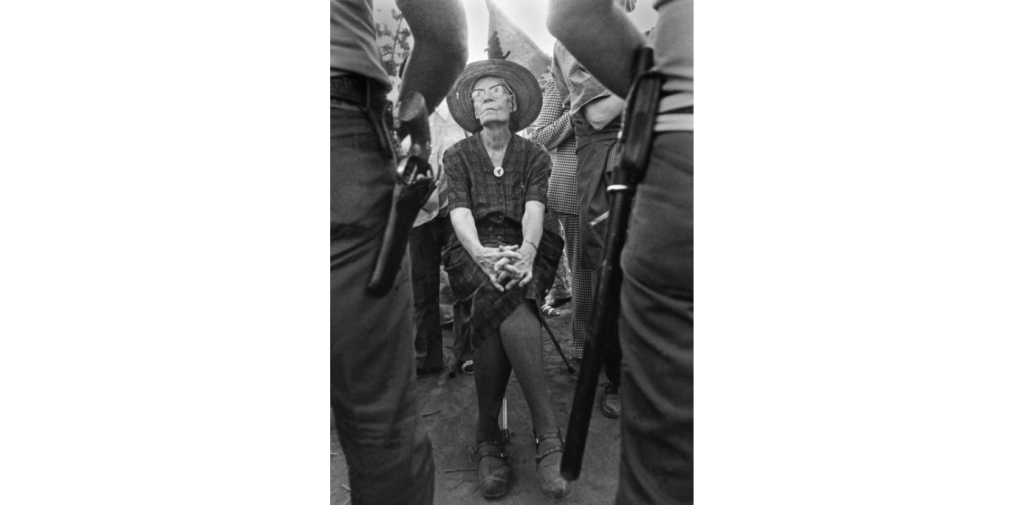
Finally, we spent some time working in groups for their final projects, but we also had time to talk more about intervention points of direct action, (https://beautifultrouble.org/toolbox/tool/points-of-intervention/) and also reflect on my favorite Dorothy Day picture (below). To have that strength in that moment is a challenge I aspire to.

(Photo credit: Dorothy Day on UFW picket line faces sheriff. When arthritis made standing difficult, Day confronted sheriffs from her portable three-legged golf stool Lamont, California, August 1973. From the Bob Fitch Photography archive, https://purl.stanford.edu/ng668fq9392)

Cookies, crumbs, community

When I was in my PhD program, I had the opportunity to teach several courses at the UNC-Chapel Hill MSW program, as well as a course in their “triangle” MSW program (though they may call it something different now). One semester I was teaching a course that students typically dreaded (Research I) and I was talking with my dissertation advisor about it. Wise and wonderful in so many ways, she gave me great advice here as well, which was to find a way to build community in the classroom so that students had some connection with each other. I can’t remember what specific strategies I attempted, but her advice made a difference in the classroom each week, and I have since woven that idea of “building classroom community” into my overall pedagogy.

Photo by Denise Johnson on Unsplash

And yet….I think I have taken it for granted sometimes recently, especially post-2020, and have just assumed that of course I am building community. This week, in a class that only meets once a week, I had this sense of needing to do something intentionally for community connection. Because we only meet once a week, and because we have a lot of content to cover, I often feel pretty rushed in there. But this week I brought cookies and at the beginning of class I told them we were going to spend a few minutes just giving them time to connect with each other. I told them the only “rule” was that they had to get out of their seat for their visiting, and make an effort to talk to people that maybe they hadn’t connected with in awhile. I loved observing it (and being a part of some of their connections).

When I was ready for them I shared with them the Mary Oliver work “Don’t Hesitate” which is beautiful through and through, and which ends with the phrase “Joy is not made to be a crumb”.

When all was said and done, this only took about 20 minutes out of class, + the cost of cookies. When class was over, several said some version of “thank you for today” on the way out. It was a good reminder for me that while much of the time we build community and make connections with people during our usual work and routines, but that sometimes we have to be really intentional about it. Community, like joy, is not made to be a crumb.

Grief and longing

Several years ago I saw a poster that said “To teach is to touch a life forever”. I like the sentiment and in general agree with it, but my experience of teaching in higher ed is that the students touch my life as much or more than I touch theirs. It is a gift that my work gives me and I feel like in general I do a good job of remembering this. But there are some days I remember this more sharply than others.

Yesterday I was on the receiving end of a call similar to one I made a few years ago. Then, I was program chair and was calling to tell our department faculty and staff that one of our students had been killed in the shooting at the Waffle House. Yesterday, I received a call from my program chair (who I am thankful to call a friend) that one of our former students had been killed in an accident related to the tornado that had passed through our area the day before. This student, Laurel, graduated with her BSW in May of 2022 and stayed at our university to study law. I had the privilege of teaching her in several classes throughout her BSW and I can say that her commitment to justice was unwavering. She was a pleasure to teach and to know, and the fact that I got to watch her knowledge and commitment deepen over 4 years is a privilege. She was a genuinely good human; full of spirit and laughter and life. Her last semester of undergrad she had a class in another department on a schedule that meant she was often in our suite during lunch time. There was one particular day of each week our schedules overlapped and she and I frequently shared food around the table in our suite. I loved hearing her plans for the future as she was nearing graduation.

As the parent of three daughters, what I have been thinking about all day today are all the times I heard her talk about her sister. With love, with joy, with pride. Laurel loved her little sister so very much.

I am at the stage of my parenting where my kids are getting older: two high schoolers and one middle schooler. We had some long planned college visits to make this weekend, and as I have been on a couple of different campuses today I have seen reminders of Laurel in many spaces and places, including that of my own children. Watching “my girls” together and thinking about how my oldest will be going to college soon is both exciting and fearful. Seeing their relationship together brings me joy; though not perfect, it is full of sisterly bonds that I (an only child) always craved growing up.

I know that I cannot feel the depths of the grief that her mother and sister and other family members are feeling. I can barely process it from my own perspective. I can only imagine the longing they are feeling.

I am faithful enough to believe that we will see her again. I am human enough to wish I could have lunch with her again in Inman 205.

I am thankful to have the gift of work that keeps me continually in the relationship of wonderful humans.

May she rest in peace and power and the feeling of being deeply loved.

Winners, losers, and nuances

I was in the car a good bit this weekend, shuttling kids from various points to other various points. I was in my husband’s car, which meant I could actually use the radio. (My car radio has been broken for….awhile.) As a result of this car change, I got to listen to the TED Radio hour. I heard two pieces that were especially good: Susan Cain: The glorious complexity of being human and Hrishikesh Hirway: Finding balance through deconstructing music The first one was about the challenge of binary thinking about people, like “introverts and extroverts”, “winners and losers”, “happy people and sad people”, and that while we do have tendencies/orientations toward certain ways of being, the fact is that we are wonderfully complicated and we contain multitudes. The second piece featured the host and producer of the podcast Song Exploder (which sounds cool too), but in the interview Hirway talked about his dreams as a musician in the context of his success with the podcast interviewing other (more famous) musicians. He had the ultimate realization that his music was important because it was important to him, even if it didn’t serve the world in some greater way. It was his work interviewing other musicians who helped him understand this, because he heard them reveal their own insecurities about their work and what it might mean, or not, to others.

These two pieces together made me think of my own life, the way I see myself, the way others see me, and the art I want to be a part of (writing). It made me think of my students, who want to do the right things in the world and in their work. This desire to do right is harder than it feels like it should be sometimes, as we know we work in an imperfect world where there are sometimes unintended consequences of actions that we take with “right” reasoning.

It made me think of, among these other things, the death this week of Queen Elizabeth. The monarchy is something I don’t really understand and have never really followed. The Twitter threads, since her passing, seem to paint her as either an overwhelming winner (determined, gracious, focused on integrity, full of wit, etc) or an oppressive loser (which I know is a weird way to phrase it) where she was at best a passive symbol of colonial history and at worst, an active participant in political and social violence.

This idea of nuance and of each human containing multitudes applies to all of us, including royalty I guess. It is hard (for me at least) to know how to hold the tension point when the stage that a person occupies is so big. Teaching that, and discussing that with students, is so much harder than talking about principles of systems theory, and social welfare policy.

Poet Lesle Honore says it so much better than I can (taken from her facebook page https://www.facebook.com/leslehonorepoetry/) on September 8:

May our memory and nostalgia

Never cloud the truth

May we hold in tension

Our entertainment

Our fascination

Our indoctrinated fairy tale culture

With the legacy

Of colonization

Imperialism

The transatlantic slave trade

The sun that never set

On oppression

May we separate the crown

And the woman

And as we bury an era

May we never bury

History

Truth

Freedoms and reparations yet to be received

God Save The Queen