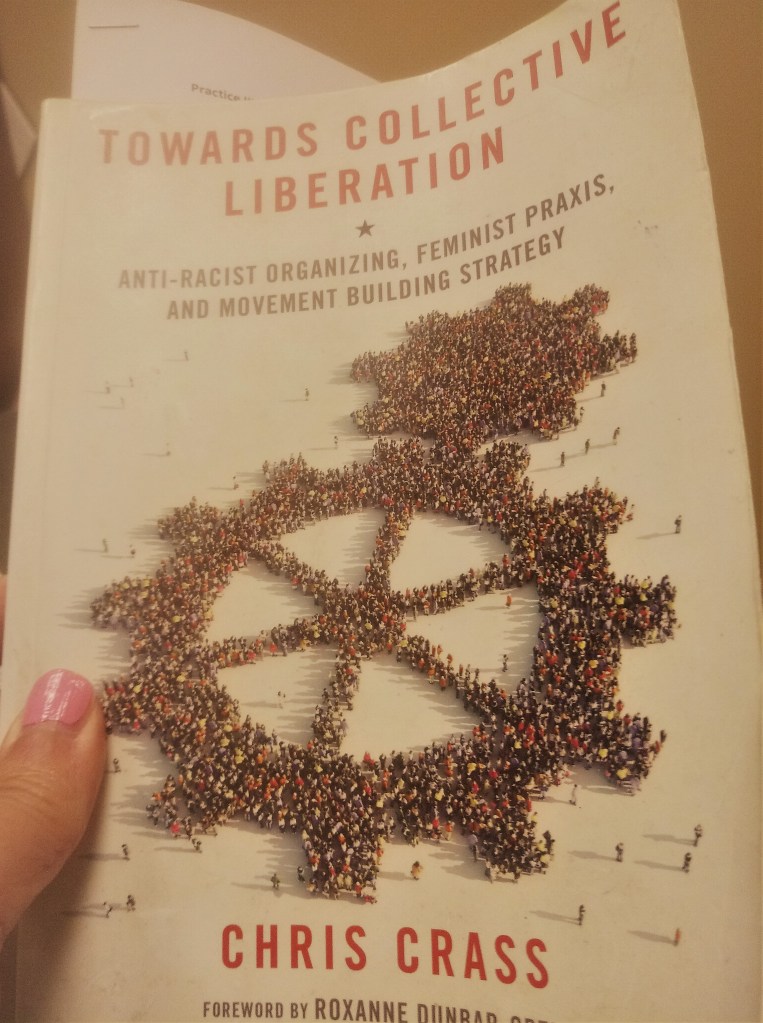
I have been teaching in a higher education setting full time for a little over 15 years and have on occasion (on frequent occasion) struggled with getting students to do their assigned reading and speak up/dialogue about what they read. There are two exceptions to this struggle that I have found. This book, Towards Collective Liberation, is one of them.
My copy of this book (assigned for 3 semesters now) is well worn. I still tune into different things when I read it along with my students. Not every student loves every idea presented in this book, to be sure, but it gets them thinking and questioning about community organizing and questioning their own assumptions about the words “anti-racist” and “feminist” and even “anarchist”. This book covers everything from the Catholic Worker movement to the sea turtle advocates in Seattle at the World Trade Organization, to local chapters of Food Not Bombs and other freedom and justice movements.
This book has led to good discussions on what empowerment can really look like, what does it mean to be accountable in community work, how do we grow leadership from the ground up, and so much more.
Obviously this book is a great choice for macro practice courses in social work education, but also a good read for anyone (teacher or learner) who is interested in learning more about activism.
Though I have always loved and appreciated American folk songs, I have listened to them even more on repeat during the pandemic. One of my favorites is Woody Guthrie’s “This Land is Your Land, This Land is My Land”. As a young girl I knew the first couple of verses but it wasn’t until a few years ago that I learned the rest of them, and it was the last three that struck me as especially powerful.
This Land Is Your Land Words and Music by Woody Guthrie This land is your land, this land is my land From California to the New York island, From the redwood forest to the Gulf Stream waters; This land was made for you and me.
As I was walking that ribbon of highway I saw above me that endless skyway; I saw below me that golden valley; This land was made for you and me.
I’ve roamed and rambled and I followed my footsteps To the sparkling sands of her diamond deserts; And all around me a voice was sounding; This land was made for you and me.
When the sun came shining, and I was strolling, And the wheat fields waving and the dust clouds rolling, As the fog was lifting a voice was chanting: This land was made for you and me.
As I went walking I saw a sign there, And on the sign it said “No Trespassing.” But on the other side it didn’t say nothing. That side was made for you and me.
In the shadow of the steeple I saw my people, By the relief office I seen my people; As they stood there hungry, I stood there asking Is this land made for you and me?
Nobody living can ever stop me, As I go walking that freedom highway; Nobody living can ever make me turn back This land was made for you and me.
Last week, I read an email that was posted to a professional list serv, So, I don’t know the person who wrote the email (beyond the name), but for some reason I happen to look at their email signature and it included a simple land acknowledgement, recognizing the Indigenous people who had lived on the land that eventually became the university. I was intrigued by this because I had never noticed anything like this on email. It made me desire to know more about the Indigenous people on the land I call my home and to think about how I can acknowledge their original presence and their forced removal, as well as how to show gratitude. I am still working through that for myself.
While I was doing this reflection, I also thought it would be a good exercise for students or other community members to engage in, to stop and remember the people who inhabited the land originally and also reflect on the events that happened that forced their nations elsewhere. This website https://native-land.ca/ is the home of Native Land Digital, an Indigenous led non profit organization. This site will help you get an understanding of the Indigenous people who were the native inhabitants of the land you dwell in today, and their blog site (https://native-land.ca/category/community-blog/) is useful as well for learning more about the maps, the process of reconciliation, and other related topics.
Here’s an example of a land acknowledgement for my current hometown of Nashville, TN that was developed by a professional organization as part of planning for their large conference to be held here: https://www.placonference.org/land_acknowledgment.cfm
I first heard the term “placemaking” at a professional conference a few years ago. I started with learning about the relationship between community attachment and positive economic impact and also about one of the core principles of placemaking, which is putting the voices of people in the community front and center in any discussion about development or re-design. From this little bit of knowledge alone I decided to integrate discussion of the concept into my macro practice class. It gave me some new and different tangible examples of community work for my students, which is helpful since sometimes community work can seem as airy as this cotton candy, bought in what happens to be one of my favorite places, Chicago.
This Ted-Talk on “Placemaking and Community” is a great introduction to the concept and the model: https://www.youtube.com/watch?v=Sfk1ZW9NRDY and here is an overview from the Project for Public Spaces https://www.pps.org/article/what-is-placemaking. There is a diagram in that link called “What makes a great place?” that is useful for a discussion starter with students or community groups in starting to think about some of the variables in community assessment.
Placemaking at its basic is about collective vision, and people working together to make the collective vision of their shared values a reality. That makes us all place-makers. I think about some of the shared values espoused in Dr. King’s vision of the beloved community: that poverty, hunger and homelessness would not be tolerated, that racism would be replaced by an all inclusive spirit of brotherhood and sisterhood, that peace with justice will prevail over military conflict and war.
What am I doing to create the place of the beloved community?
The concept of placemaking also makes me think of one of my favorite Old Testament prophecies, from Isaiah 58:12: Your people will rebuild the ancient ruins and will raise up the age-old foundations; you will be called Repairer of Broken Walls, Restorer of Streets with Dwellings.
I love history, and I think of myself as a fairly well rounded reader, but there were so many names and details in each of these brief reads that I didn’t know. When I learned about women’s suffrage, I mostly learned about Elizabeth Cady Stanton and Susan B. Anthony, sprinkled with a little Alice Paul and Dorothy Day. I had never heard of Zitkala-Sa or Mabel Ping-Hua Lee and others. And the women whose names were familiar to me (Ida B. Wells Barnett and Frances Ellen Watkins Harper and Sojourner Truth) created more impact than I knew. The resources I came across were a good and necessary reminder that it took the work of many women to gain the right to vote. Bigger than the issue of suffrage, it also makes me wonder how many other names I need to learn as I work to recognize with gratitude all people who have worked and are working toward the beloved community.
One last resource to share, from The Sojourner Truth Project: a selection of video recordings of her famous speech “Ain’t I a Woman?” in contemporary Afro-Dutch dialects https://www.thesojournertruthproject.com/the-readings. I love hearing her truth in other voices.
In a late night class prep session for my Policy I course, I came across this article on “Applying a Racial Equity Lens to Housing Policy Analysis”. If you are interested in affordable housing, racial equity, connections of both to our public school systems and developing targeted solutions to problems, you should read this: https://housingmatters.urban.org/articles/applying-racial-equity-lens-housing-policy-analysis
If you are not a policy wonk (yet), however, I propose there is a part of this article that is worth thinking about, and that is the importance of explicitly naming something. These authors discuss the importance of naming the inequity that has resulted from structural racism embedded in policies. Being explicit and honest about the way that racism has been embedded in policy (whether housing policy, education policy, welfare policy, etc) is a first step toward identifying thoughtful, anti-racist solutions. And it is a necessary step, because we can’t address something we aren’t honest about naming in the first place.
This is true in policies, in our family life, in our congregate life of faith. It is true in our individual relationships at work and in other community spaces. I have to be honest, unflinchingly so, about the ways racism has permeated my actions and about the ways I have benefited from racist structures even if I didn’t take an active role in it.
Along these lines, I came across this 21 day challenge: https://www.eddiemoorejr.com/21daychallenge/ For 21 days you are challenged to do one action (Read, Listen, Watch, Notice, Connect, etc). I started it recently and there are so many wonderful resources and suggestions for actions there, just waiting for you. This seems like it would be a great challenge for students, friend groups, work groups, faith community groups and others to do together.
I have heard a number of calls this summer for the need to “get comfortable with being uncomfortable” in terms of talking about racism, effects of racism, police violence, polarizing politics, and more. I agree that it is important to have these, and I also think it is important to prepare for them. Fortunately, there are many resources available to help with having those conversations.
I have shown this before in class with college students, but it would also be appropriate for community settings and high school students as well. From this Ted Talk you can go into establishing some boundaries and expectations for your own uncomfortable conversation. The Center for Research on Teaching and Learning at the University of Michigan has some great guidelines for discussing difficult and “high stakes” topics that I have also used a number of times, and they are also relevant to helping people prepare for leading these kinds of conversations in multiple settings (faith communities, classrooms, K-12 school meetings): http://crlt.umich.edu/publinks/generalguidelines Teaching Tolerance has a curriculum for having difficult conversations that is built for K-12 settings, but can also be adapted easily for use in higher education and community settings http://www.tolerance.org/sites/default/files/general/TT%20Difficult%20Conversations%20web.pdf
As an added bonus, Emmanuel Acho has developed a collection of videos called Uncomfortable Conversations with a Black Man. These are videos that can be useful for families to watch together, they could be used in classrooms, they are a tool for you to watch and reflect on personally and then discuss with someone. You can learn more about this work, his upcoming book, and see the videos here: https://uncomfortableconvos.com/ I especially have valued the one addressing race and religion (episode 7), as well as the one about helping parents to raise children to see color (episode 3). The videos are one way to start your own conversation in your own community, whether that is your family, your faith community, or your community of learners.
Yesterday I was at the dentist and at the mercy of what they had on the television. It happened to be Good Morning America which is not something I would normally tune into, but I am so glad it was on during my cleaning because I got to see their discussion of colorism. Here is the link to the segment and the transcript: https://www.goodmorningamerica.com/style/story/colorism-people-color-overcome-insecurities-biases-71875856
Last week I had the chance to read the book and it was AMAZING. Great character development, a book that spans generations, deals with racism, family stories, family secrets, identity struggles, and….colorism.
This would be a fun book selection and interview/segment review for a group of friends wanting to learn and enjoy the story. It would be a great book critique assignment and mini lesson for a diversity class in any discipline, and it would be a useful component of an Employee Resource Group examining issue such of diversity and inclusion and equity. In short, this collection of resources on colorism is good learning for a variety of contexts.
“Her death hit in waves. Not a flood, but water lapping steadily at her ankles. You could drown in two inches of water. Maybe grief was the same.”
This quote by Susan B. Anthony is the heart of what I focus on when talking with students (or anyone) about voting. I want people to vote, and I want us all to take that responsibility seriously…which means being prepared and being thoughtful (full of thought) about who it is we are electing. Whether you are thinking about how to talk to students about voting…or your friends or neighbors or whomever…here are some great resources and things to consider. Don’t let Susan B. down.
.Susan B. Anthony, circa 1855
With students, I usually start off with some perspective/opinion questions like “How do you define political engagement?” “What did your family teach you, directly or indirectly, about voting?” and, if I am feeling really brave, “Does your individual vote mean something? Explain”. Sometimes I have also given students the “homework” assignment to pick 5 people in their lives (friends, family members, co workers, etc) and ask them if they have voted in a local, state or federal election in the last two years and if they intend to vote in future elections. It is always interesting to hear them reflect on the reasons people give for voting or not voting.
Once we have the basics covered, I make sure they know how to find out what the ballot is going to look like so that they can be prepared. If students are willing to enter their address, they can find out all the offices and issues that will be on their ballot: https://ballotpedia.org/Sample_Ballot_Lookup And it is always good to know where it is that you should be casting your vote: https://www.vote.org/polling-place-locator/
Stepping back to take a broader look, I also have students examine the major US party platforms, such as https://democrats.org/where-we-stand/party-platform/ and https://www.gop.com/the-2016-republican-party-platform/ and https://www.gp.org/platform and https://www.lp.org/platform/. Sometimes I have students review this outside of class, and ask them to look at how each party addresses issues related to poverty, immigration, public education and marginalization of women and members of diverse groups. Sometimes I break students into groups and have each group review the party platforms in search of answers. Some of the questions I have them answer are: What does the Democratic party say about cash assistance? What does the Republican party say about minimum wage? What do each of the parties say about the right of healthcare? What do each of the parties say about the needs of public education? The key thing is that students are reviewing the party platforms rather than other news sources, so that they can see what each party has to say about these issues “in their own words”.
Depending on how much time I am spending on the discussion of voting and what the objectives of the class are, I also show the electoral college map for the recent presidential election. You can find them from several different sources but you probably can’t find one more detailed than this from the 2016 presidential election: https://www.nytimes.com/interactive/2018/upshot/election-2016-voting-precinct-maps.html. Again depending on the objectives of the class, we may also look at voter turnout in recent local, state and national elections as well as patterns and trends of voter turnout according to age, gender, education level, and other demographics. This is a good beginning source to get at data by state and by some other demographics: http://www.electproject.org/home/voter-turnout
Finally, another resource I share with students and interested others is this one, which allows you to see how your Congressperson voted on any bill on the House or Senate floor: https://www.govtrack.us/congress/votes It takes a little bit to learn to navigate fluidly but it is worth it.
I hope these resources are helpful to you as you think about voting and about encouraging others to vote!
We lost two great men this weekend, two original builders of beloved community: Congressman John Lewis and Rev CT Vivian. They were friends, fellow activists, fellow servants, and left this earth on the same day. People may be more familiar with John Lewis because of his longtime service in Congress, but each of these men were faithful in their work with Dr. King in the Civil Rights movement and faithful in their work in pursuit of the Beloved Community throughout their lives.
Here are some great resources to use in teaching or in learning about these men, their legacy, and how we can build on their work:
I just saw the documentary John Lewis: Good Trouble which came out earlier this month. It tells Lewis’ personal story and also the broader story of activist work during the Civil Rights Movement. The documentary also switches back and forth from the past to the present. As you are seeing footage of the work that went into getting the Voting Rights Act passed, you next are watching news clips and footage from 2013 and beyond that show acts of voter suppression. For teaching about voting rights alone, this documentary would be great for social work policy classes, US history classes, and political science classes. Beyond the voting rights work and voter suppression concerns of today, another powerful piece of this documentary was seeing the young college students in Nashville undergo training to be prepared for the lunch counter sit ins, and seeing the footage of the sit ins. It brings a good topic for reflection/discussion: What is the work I am called to do? What change am I to be a part of? How am I making myself ready?
It was also really poignant to hear John Lewis’ brothers and sisters talk about him when he was younger, and talk about his preaching to the chickens, his desire for education, his faith. It made me think of his brothers and sisters and parents as “good ancestors” in that they could envision his future work and they supported him how they could so that he could prepare. What is the work that we need to do in order that we can be a good ancestor for racial equity and for justice for all?
You can see this on Amazon Prime, Google Play and other digital platforms on demand. I watched it on Amazon Prime for 6.00.
A few years ago, the March trilogy of graphicnovels was published (authored by Lewis, and Andrew Aydin and Nate Powel) to tell the story of key events in the Civil Rights movement. Though alot of times we associate graphic novels with kids, these are beautiful novels. Here is a reading guide developed for university students to accompany the first book and could be adapted for any university discipline or really any community setting: https://sites.lsa.umich.edu/marchingforward/wp-content/uploads/sites/500/2017/06/MARCH_ReadingGuide.pdf
Here is a commentary from Sojourners that is a beautiful look at the faith that drove CT Vivian in his civil rights activism: C.T. Vivian Wanted Us to Remember: The Civil Rights Movement Was Deeply Spiritual. https://sojo.net/articles/ct-vivian-wanted-us-remember-civil-rights-movement-was-deeply-spiritual In this you can see the power of a faithful grandparent in the shaping of a young child, and a young man who saw God in his work.
Here is a Library of Congress Oral History interview with C.T. Vivian, recorded in 2011 for the Smithsonian National Museum of African American History and Culture. https://www.loc.gov/item/2015669105/ It is a 4 hour interview but rich with detail. He talks about his childhood in the Depression, and also how his mother and grandmother planned ahead and moved so he could be educated in a desegregated school and eventually go to college. (Talk about some visionary women!) He talks about his early work in sit ins in Illinois, his shift from business when he got the call to ministry, how he and his wife answered that call. It is answering that call to ministry which brings him to his time in Nashville at American Baptist Theological Seminary, where he met other civil rights activists including John Lewis. Both Vivian and Lewis learned from James Lawson, and this is where Vivian began to practice the principles of nonviolent direct action in the sit ins of Nashville and other locations. Some of the most emotional and poignant detail is when he is reflecting on organizing the plans for the 1961 Freedom Rides and the commitment to nonviolent action even when others are acting with violence toward you. He also talks about other events in that era that are less well known (or at least, were less well known to me) and shares how he learned of Dr. King’s assassination and of traveling to Memphis after he got the news. Aside from learning history, and first hand reflections on strategies of non violent direct action, this interview also really illustrates the importance of relationships and being in community with people who have the same vision and commitment as you do. It is powerful.
And finally, along the lines of relationships, see these fierce and faithful men looking at the jailers, convinced in the rightness of the work they were doing:
I love babies. My children call me a baby addict. I love their coos, their squishy cheeks, their ability to wrap grown people around their tiny fingers…and most of all, I love their potential. So much potential to create, heal, inspire…wrapped up in a blanket and often with a stinky diaper. All kids have it (the potential, and the stinky diaper)…but we have a child welfare system (a system created to protect children) that creates inequity and in this sense goes in opposition to its direct mission.
I worked in child welfare before I had my kids. On a purely personal level, my deep desire is that all kids have someone to love them as much as I love my kids. I don’t have a perfect track record as a mother but I love them with my whole heart. Every kid deserves that kind of love. On a professional level, my deep desire is to address disproportionality in child welfare systems.
Disproportionality means that there is an underrepresentation of some groups, and an overrepresentation of others. What we hear most about in terms of this issue is the overrepresentation of African American and American Indian/Alaskan Native children (they are more likely to be removed from their parents’ homes, more likely to have placements in group care settings than foster homes, etc). That’s my focus here today.
It is important to look at disparity in how we work with families and children, because disparity in approach leads to inequity in outcomes. If you train social workers or other helping professionals, or teach people who want to be these things in the future, I hope the resources at the end of this post help you frame a discussion and class session.
If you are not a social worker or other helping professional, you still have a voice in this and a role to play. Every state has a public child welfare system that should be concerned about this issue. Look on their website and see what they are doing to address disproportionality. Ask them to fully fund resources that work with families and children at the stages of prevention and early intervention. Ask them how they train their employees to be culturally sensitive. If you want to volunteer in child welfare, no matter where you live in the US, you could be a CASA (court appointed special advocate) or serve on the foster care review board (FCRB) for your county.
There are so many ways to make a difference in the life of a child!