Loaves and Fishes

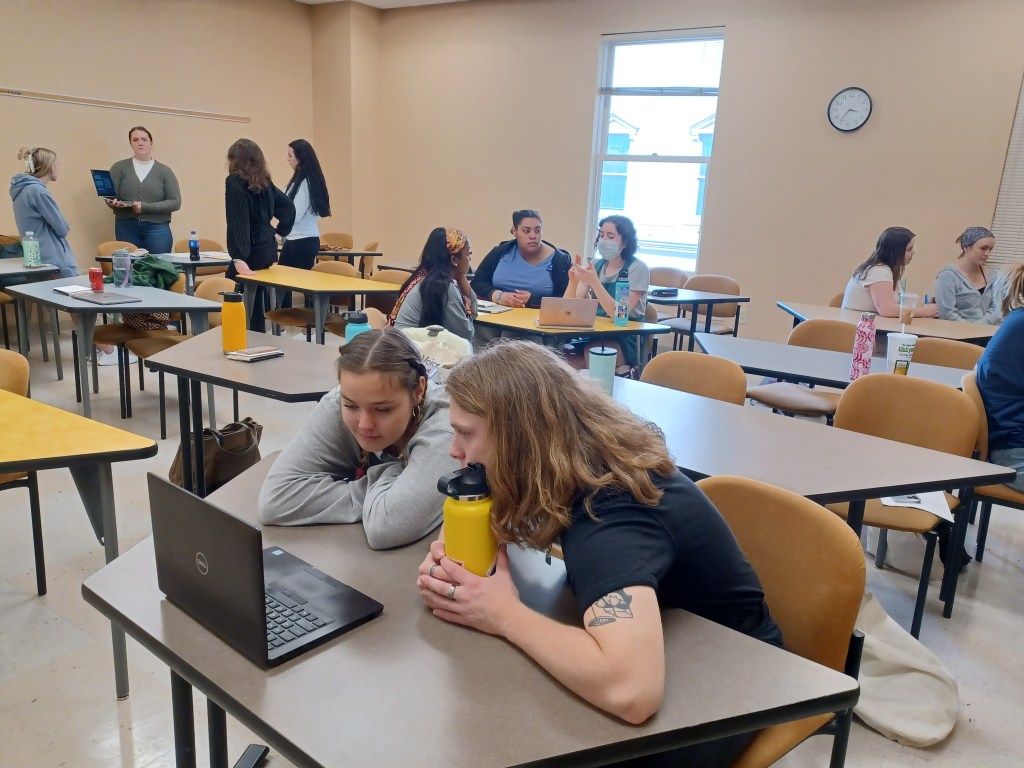
A few weeks ago, on a sunny day, I put my students in pairs and told them to go for a 15 minute walk and check in on each other, and to specifically ask “What are the words you need to hear right now?” When they got back from their (much appreciated) walks, I asked them if anyone wanted to share what they had said they needed to hear. The answers were not that surprising, because we are all sharing space in the same bonkers world, but the honesty with which some of them answer always takes me by surprise. I heard things like “I wish someone would tell me the world doesn’t have to sit on my shoulders” and “I wish someone would tell me it is okay not to have things figured out” and “I wish someone would tell me anything, that they would just be there for me”.

I thought then of the poem “Loaves and Fishes” by David Whyte. It goes like this:

This is not
the age of information.

This is not
the age of information.

Forget the news,
and the radio,
and the blurred screen.

This is the time of loaves
and fishes.

People are hungry,
and one good word is bread
for a thousand.

People are hungry for good words, for people who will speak life around them and to them and into them.

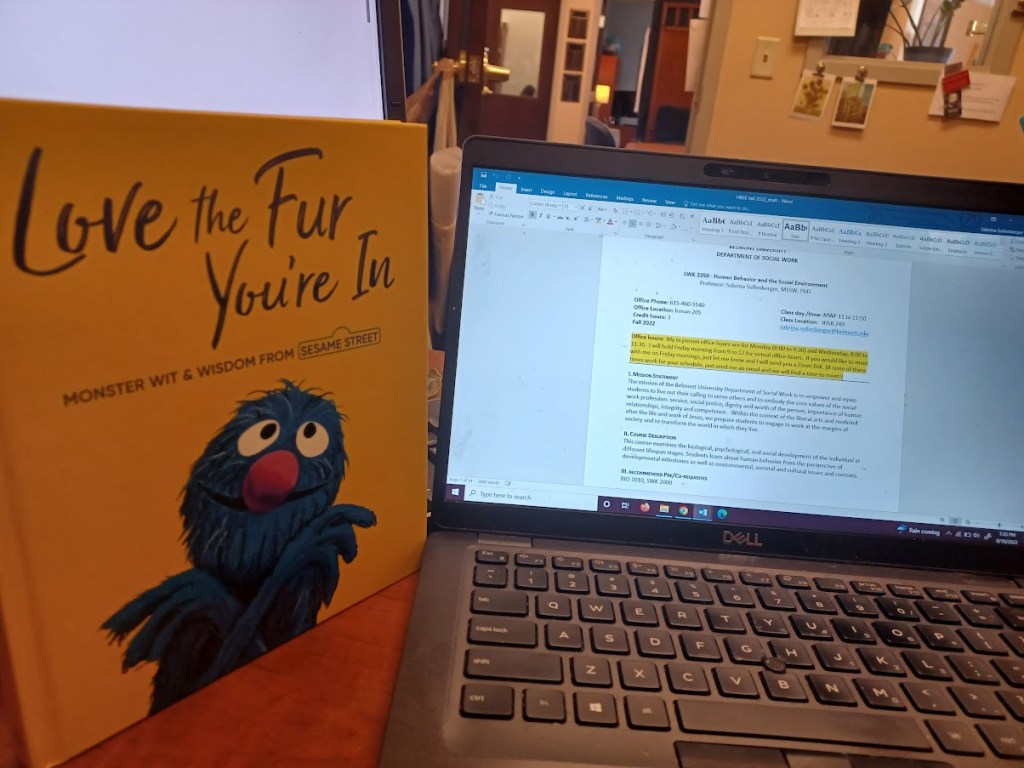
I came into my office today in between classes and saw some cards left by students in honor of social work month. It was the highlight of my workday (and maybe my whole day, minus seeing my kids), to feel seen and appreciated and loved.

In terms of what it would take to build the Beloved Community, Dr. King wrote about agape love. He described it as “understanding, redeeming goodwill for all,” an “overflowing love which is purely spontaneous, unmotivated, groundless and creative” (from The King Center https://thekingcenter.org/about-tkc/the-king-philosophy/) He went on to say that agape love didn’t discriminate between unworthy and worthy people, and made no distinction between a friend and an enemy. Finally, he said, this kind of agape love is the foundation for community.

This is what I want to have flow out of me when there are stressful meetings at work. This is what I want to flow out of me when the food server gets my order wrong. This is what I want to flow out of me when students ask the question I. Have. Just. Answered.

This is what I want to flow out of me when it seems easier to keep the mask on, either literally or figuratively.

I want agape love to flow out of me and I want to speak words of light and truth. And, like the parable, I hope that though my words are simple “loaves and fishes”, that they have a reach beyond what I can imagine or plan.

Remembering DeEbony

It was April 2018, a Sunday afternoon, and I was driving back from a volleyball tournament in East Tennessee with my three daughters in the car. They were all asleep when I took a call from my Dean while coming through a mountain pass. While it was unusual for her to call on a weekend, it wasn’t completely abnormal, especially at the end of a semester where there are so many moving parts. So, I answered the phone while driving, not thinking that anything would be wrong. She asked me first if I had some time to talk, and I told her I was driving and had plenty of time. She asked if my husband were in the car. Upon hearing he was not, she asked if I could pull over and talk with her for a few minutes. There wasn’t a place I could pull over then, but I told her I would be fine, again, not imagining what she was about to tell me.

She told me one of my students, DeEbony Groves, had been killed in the early morning at Waffle House. She had just learned this from university officials, and wanted to let me know before I heard it on the news. I just kept saying “no!” over and over again, so emphatically and increasingly louder, and my children woke up confused and frightened. I did find a place to safely pull over, and I called the faculty in our department as well as our program assistant. (I was the Chair at the time, and wanted to let our faculty and staff know before they heard it from others.) I also talked with the director of our university counseling program, to put some preliminary plans in place for meeting the needs of our students.

These are pics from her friends and social media, collected in Spring , 2018 after her death.

The days and weeks that followed to the end of the semester passed in a blur. Reaching out to DeEbony’s family to offer comfort and what support that we could, plus meeting the needs of all our students, took priority. (Mourn with those who mourn).

Gradually I heard and read more details of the shooting, and of the shooter. I learned of his background of mental illness and his previous threats to others. I learned of the laws that both removed his guns and yet didn’t keep his father from giving his guns back to him. I visited the local offices of our senators and pleaded with their assistants about the need for gun reform/control. I told them about DeEbony and how hard of a worker she was, how she perpetually ran late but made up for it with her colorful entrances to class. I told them how she had taken an interest in policy that was surprising to her. I told them if that were my children, I couldn’t imagine what I would do, but I would be angry, angry, angry. (Pray for the dead, and fight like hell for the living.)

Fast forward to early 2022. There has been very little progress at the federal level in gun violence prevention, and where I live (Tennessee) is definitely not a leader in state reform and prevention efforts. I keep teaching my policy classes, and asking students to think about how the broader social environment (including witnessing and experiencing violence) affects us all. I keep voting. I keep writing letters. (I keep wondering if it makes any difference.)

I keep remembering DeEbony. Just yesterday, her killer was found guilty on all counts, not only for DeEbony’s death but for the death of the other victims (Joe, Taurean, Akilah) as well as the injuries sustained by others. The finding of guilty is something. I can imagine it brings a measure of peace (maybe?) to their families. But it doesn’t bring their loved ones back. It doesn’t change the trajectory of time for the families, it doesn’t change the outcome for them in the loss of their loved ones. (What is the origin of the phrase “justice has been served? anyway”)

Has justice been served? What does it look like, moving forward? Does it hold the shooter’s father accountable? Most of all, what I hope justice looks like as we move forward is strengthening local, state, and federal policies around preventing gun violence. (There are so many facets to this issue; so many ways to do the work.)

Here are some resources to help with your own thinking, your advocacy, and your teaching if you teach these topics: https://everytownresearch.org/rankings/ and https://momsdemandaction.org/resources/ and https://www.whitehouse.gov/briefing-room/statements-releases/2021/06/23/fact-sheet-biden-harris-administration-announces-comprehensive-strategy-to-prevent-and-respond-to-gun-crime-and-ensure-public-safety/

On a different note, I also share this as a way of honoring DeEbony: a link to Maya Angelou’s “Still I Rise”. There are some verses in here that make me think of her: she was rising, she was strong, she was dancing, she was sassing. (And I believe that somewhere, she still is.)

Still I Rise: https://www.poetryfoundation.org/poems/46446/still-i-rise

“A writer’s heart is always breaking…It is through that broken window that we see the world” (Alice Walker)

One of my laments in life these days is that I don’t have time to read as much as I would like to do. I know a number of people who feel the same way. On the eve of the beginning of Black History month, I wanted to share 5 of my favorite authors, voices of Black women who have shaped me in various ways and at various times in my life. Their voices, and their courage in writing, have changed the way I see the world. Sneaking in an Alice Walker quote at the beginning means I am actually sharing six of the voices who have shaped me most.

bell hooks. How can I even begin to think of all the ways her words have shaped me? Pick any of her books, and keep going. I probably learned (and was challenged to think more about) intersectionality from her than any other author. I was in my late 20’s or early 30’s before learning about bell hooks, and I love to introduce students to her work. You can also learn more about her at the bell hooks center @ Berea College: https://www.berea.edu/bhc/about-bell/

Photo credit: Oprah Daily (Ten Essentia bell hooks books)

Roxane Gay. Bad Feminist is my favorite of hers, but everything I have read is good: https://roxanegay.com/ I got to know her work through seeing the title Bad Feminist at the library,and the rest is history.

Rachel Cargle. https://rachelcargle.com/ I first got to know her work through a TED Talk, have read several of her short pieces, and last year in 2021 followed her daily prompts to learn about Black history. I shared these prompts every day in class (for whatever group of students I had that day) and loved learning together with them.

Toni Cade Bambara, author of much, but what I love most is the very first short story I remember reading and re-reading and loving. I love Raymond’s Run even now, 40 something years after first reading it. I actually want to find it now and read it again, this story of a determined sister and her relationship with her brother. It was probably my first time reading a story that included a character with disabilities.

Natasha Trethewey. I have come to appreciate her poetry (she was a two term US Poet Laureate) but learned of her first via her memoir Memorial Drive in which she talks about the murder of her mother. She talks about this tragedy in the context of intimate partner violence, her mother’s coming of age in the Jim Crow south, and more. She decided to write the memoir after seeing her mother’s murder referenced in a story about her (NT), and she decided she didn’t want her mother’s life to be just the equivalent of a footnote in her own.

Surface Pressure

Pressure like a drip, drip, drip, drip that will never stop.

Woah.

This line is just one of many apt descriptors in Luisa’s song (“Surface Pressure”) in Encanto, and it is what I am feeling these days. January has felt like it has had 74 days in it, minimum, and we still have the rest of this week to go.

Photo credit: Disney

Alot of times when I feel out of sorts, and stressed out, I try to look for the positive and remember my blessings and other good things. I practice gratitude, and it helps. The past couple of weeks, however, I have more often been trying to just be quiet, not harm people with my attitude, and remember that life isn’t always going to be this way. (And I am grateful I can have this perspective.)

I look at the “conversations” people have on social media and want to weep. Or curse. Or both. I am sad for my personal children who are having such critical years shaped by COVID. I am sad for my college students who are trying to navigate being away from home, with all the developmentally typical challenges of college, plus COVID. I am sad for specific people who have lost loved ones. I am sad in general for collective groups of people, and K-12 teachers and health care workers are at the top of that list. I am sad because I feel like there is nothing I can do to help in any meaningful way, beyond staying home when I can and minimizing risk of catching and spreading COVID. And I have anxiety about the things I should be doing that I don’t have the energy for after two years of pandemic related decision fatigue. In short, I feel like a hot mess of feelings mixed with a healthy dose of exhaustion, and a side of apathy.

If you have never seen Encanto, I recommend it highly. If you have seen it in the background, I encourage you to go back and listen to Surface Pressure. I played it for my senior social work majors the other day in the capstone class I teach. I told them that this song spoke to me in a big way over the winter break. Below are the existential type questions and observations Luisa asks herself in the song. How many of them do you resonate with?

I’m pretty sure I’m worthless if I can’t be of service

Who am I if I can’t run with the ball?

Who am I if I can’t carry it all?

Under the surface I hide my nerves and it worsens

Who am I if I don’t have what it takes?

It is a bundle of fun, my class is….seriously though, we had a good discussion about the weight of expectations, both our own and what others have for us. We talked about generational trauma and the roles we play out in our families. We talked about how we can terrify and harm the very people we seek to protect when we don’t know our limits and when we feel pushed beyond what we can take. And we talked about why it is we feel we have to take so much on.

But wait

If I could shake the crushing weight of expectations

Would that free up some room for joy?

Or relaxation? Or simple pleasure?

Luisa has her own aha moments, and I (occasionally) have mine, and I try to walk alongside my students as they have theirs. I am taking a little bit of time every day to free up some room for joy. Ask people in your life how they are doing that for themselves. Ask yourself what you can do to make sure you have some room freed up for joy, and relaxation, and simple pleasure. When I don’t ration out the time for my own joy, I am less likely to ration it out for others. And that is part of #belovedcommunity.

From “eh” to “ah” (and “aww” and awe)

I had limited time in the fall semester to write. I feel like I made it through the fall semester with the skin of my teeth, whatever that means. I had no desire to write over our very short break (winter graduation on Dec 17, classes began Jan 5) and then the semester started virtually and I have been very “eh” about it. Thankfully, we resume in person learning next week. (Also thankfully, we have good vaccination rates and a mask mandate on campus.)

I zoomed the first few classes, but given that today many students were making their way back to campus from various places across the country, I had my 3 classes today be asynchronous. Each of these involved a discussion board as well as an individual submission of a small assignment. I read the discussion board for one of the classes tonight and went from “eh” to “ah” to “aww” and awe in the space of an hour.

I took this picture on the campus of Queens University in Belfast, where we were when the world turned upside down in March 2020. I don’t know anything else about it, sadly, but it mirrored my feelings that day.

This is a class focused on understanding human behavior and development in the lifespan. We spend the first few weeks setting the stage talking about the effects of “big picture” things like how culture and economy and politics and other aspects of our social and physical environments affect us. We also talk about the interplay of the systems within us (biological, psychological, social and spiritual). I got through the key content in our zoom on Tuesday, so for the discussion board I asked them to respond to one of a selection of scenarios or application questions. I offered a range of choices, so that people could choose to share as much or as little about themselves as they felt comfortable doing so. And, I did not require peer responses (as I normally would if this were a fully online class).

They have until midnight tonight to respond, so I haven’t read all of them, but when I looked at the board a couple of hours ago 19 out of 24 had already responded. Their reflections/responses to the questions and what they chose to share were a whole range of things. They were processing alot of grief about the pandemic, about their first experiences with losing a loved one; they were sharing about their struggles with spirituality and faith. They shared about their fears of disappointing people. They shared about loneliness. They also shared happy moments, some big wins and some brushes with fame and the joy of seeing people that they hadn’t been able to see in awhile.

Eh: I don’t like teaching on a screen. Zoom fatigue is real.

Ah: People are often hungry for space to share. I need to remember that.

Aww: I can still be authentically surprised and encouraged, even after 15 years of teaching.

Awe: People are complicated. We are fearfully and wonderfully made and we (most of us) have issues. We also have a lot of depth for compassion. One of my students said she didn’t have faith, per se, but she believed we all had a part in “righting the universe” through our service to others.

“This joy that I have”

About a year ago I heard the Resistance Revival Chorus “This Joy”. I listened it to it multiple times a day for probably months in a row. It got me through a lot of the pandemic. I still listen to it regularly. If you have never heard this version (or have never heard the song at all), give it a listen. You will be hooked. The original is by gospel singer Shirley Caesar.

This is a season of the year where we are frequently reminded to practice gratitude, to articulate the people and things for which we are grateful. I have been working on this especially the last couple of weeks as a means of mindfulness and being aware.

Today I spent most of the day at our church retreat. Even though we have a high vaccination rate among our members, we spent most of the day outdoors. I haven’t spent so much of a day outdoors in a long time. We walked, we played Quidditch (for which my body will hate me tomorrow) and I spent some time just laying (lying? after all this education, you’d think I could remember) on the leaf-filled grass, looking up.

I did not grade policy tests, do lesson plans, create a community practice exam or make follow up phone calls for some community work. All the things on my to do list for today because they didn’t get finished over the week. I will do some of them this evening, but it will not take away from the joy I had today.

I laughed, I watched my children, and really enjoyed the sunshine. I rested.

I got into my car to come home this evening, and this song was the first I found in my playlist. What a lovely end to my day of rest. I am so grateful to have had this day. I needed it.

If you want more info on the science of practicing gratitude, check out:

https://greatergood.berkeley.edu/article/item/how_gratitude_changes_you_and_your_brain

Healing

Today has been pretty gloomy and it is only 9:20. Drove my daughter to school in the chilly rain on a few hours sleep. It is a busy season at work and home.

Even amidst the temporary gloom, reflecting on a bright spot from last week, as well as an a-ha moment, I was reminded of this micro-poem by Liezel Graham, beautifully illustrated by Kimothy Joy. (You can find the author and image here: https://liezelgraham.com/2019/01/20/every-woman-who-heals-herself/ )

It was Friday, and I was in a community space with a group of women. It was a multigenerational gathering, and people from different paths. There was diversity in race, education, income, life experience and other dimensions. One of my wonderful colleagues was sharing/leading us in an activity about what to keep and what to throw away related to family communication and other family patterns. As each woman shared, I could hear so many commonalities in what we experienced as hurtful as well as what we experienced as nurturing and loving. This in itself was helpful to see but what seemed to mean the most was just that we had some intentional space to share and to “be”. I am hopeful this will be a regular space and place where we can continue to be in community with each other. The power of being able to share and be heard, to listen, and to support should not be minimized or held lightly.

Confronted with the “fierce urgency of now”

I had conversations with two people today that were reminders that the world is full of hate and loss. I also had the chance to go to a celebration of life for someone who was 95 when he died, and who leaves a legacy of love and faith and steadfastness.

There is something about someone’s “homegoing” that makes most people, me included, reflective about how they are spending their time.

“…There is an invisible book of life that faithfully records our vigilance or our neglect. “The moving finger writes, and having writ moves on….” We still have a choice today: nonviolent coexistence or violent coannihilation. This may well be mankind’s last chance to choose between chaos and community.”

Where Do We Go From Here? Chaos or Community? By Dr. Martin Luther King, Jr.
Image taken from Salvaged Faith, https://salvagedfaith.com/2016/08/07/the-beloved-community/

When I think about how I am spending my time, I think about what is most important to me in terms of my relationships. And I think about my work. And I think about my calling to be various things, including an ally and a bridge builder and restorer. When I think about what it is I am vigilant about and what it is I neglect, I (in the words of Dr. King) think about the choice between nonviolent coexistence or violent coannihilation. I also think about the choice between speaking up (however imperfectly) or being silent, and between showing up (however imperfectly) or being absent. I think about the choice to be intentional in our relationships and in my efforts to build community (however imperfectly).

In what feels like a million years ago, I read the Steven Covey books as part of a leadership program at an organization where I was working with children and families. There are some things I could take or leave in these books, but a couple of things have stuck with me. One of the things is this: to be proactive is to make choices on deeply held values.

I have been stressed lately (as usual) with more things to do than time to do them, and have felt like I am really just surviving day to day in terms of doing the work in front of me. That doesn’t feel proactive in the way I usually use that word. But. I said “yes” to work that is meaningful and to things I believe in and to things I prayed for. I value and hold dear the root of all the things I said “yes” to, and now (when it is all coming to a head at once it seems) I am trying to just do the next right thing for each of these. Pretty imperfectly, but still proactive. Still in pursuit of community. I am confronted with the “fierce urgency of now” (also from Where do we go from here?). I also know I need to rest.

What is your fierce urgency?

What we permit, promote, and prohibit

Earlier this week, when news broke about the Haitian immigrants at the border of Del Rio, I couldn’t comprehend it, just in terms of the sheer numbers of people. When I saw images of people being chased by DHS officials on horses, I couldn’t process it. Then I saw Bernice King’s tweet, pictured below, and I finally had to stop trying to cognitively run from it.

I teach a policy class each fall, and while I have set things I always talk about (TANF, Social Security, child welfare policies, etc) I also try to be responsive to the political and social issues that are unfolding throughout the semester. I do this not to be reactive, but to be intentionally responsive and show students in multiple ways that policy (and implementation of policy) affects people. Policy can constrain rights or expand them; it can facilitate access to resources and supports or it can limit them. Policy shows what we value, what we will permit, what we will promote, and what we will prohibit.

Today at the end of class I asked them to tune into this topic over the weekend, and that Tuesday we would talk about some of the policy implications of this, both current and historical.

Here are some of the sources I am using in my pondering and preparing. I kind of dread it; it will be complicated and messy…but I think it is important.

https://thehill.com/search/query/haiti

https://sojo.net/articles/want-support-haiti-prevent-western-exploitation

https://www.bbc.com/news/world-us-canada-58654351

https://immigrationforum.org/article/fact-sheet-temporary-protected-status/