A few weeks ago my daughter and I went to a local museum (The Frist) to see their current installation called Printing the Revolution. It is powerful. One of the first pieces you see when you walk into the gallery is a piece with names and facial drawings of people of color who have been killed by police violence.
I was telling my daughter about a song I often play for my students that has the names of people of color killed by police and that most every semester there are new names to add to the lyrics.
This semester we add the name of Sonya Massey.
We have some evidence for strategies that work, like these from the University of Michigan: measures to reduce excessive force by police These are ways to intervene systemically.
If you haven’t read it, please get a copy of the book My Grandmother’s Hands. The author is a social worker, and the main focus of the book is examining race-based trauma and how we are all affected by it. There is an emphasis on healing based on neuroscience and somatic methods. This is how to make a difference in your individual life. Read it more than once.
I don’t have a good closing or wrap up for this piece.
During 2020 and 2021, I (like many others) took a lot of walks. Usually I walked alone, or sometimes with my daughters. A few times, I took walks with friends. One day, after walking with a friend who happens to be one of my favorite walking partners, I kept reflecting on our conversation long after the walk.
Since it was during the COVID era, I also dabbled in more creative writing than I had in several years. The walk, plus the reflection, plus the dabbling resulted in a publication that just came out a few weeks ago.
In the length of time between submission, acceptance, and publication, I grew unhappy with the writing or, more accurately, the piece itself and what it represents. I feel like the world hasn’t changed very much since then, with respect to what mothers have to worry about for their children. And I remain a very imperfect ally.
But every day, I get a chance to make different choices and take different actions.
Here’s to more walks with friends, more praxis (reflection on action) and more action (action of the John Lewis “good trouble” and Bayard Rustin’s call for “angelic troublemakers” in every community.)
I have written before about using podcasts in teaching: here, with how you might use the Do No Harm Podcast and here, with ideas for using The Call, which is an episode of This American Life podcast. For various reasons in the past week, I have been by myself in the car more than usual and have had time to listen to another podcast called Inconceivable Truth.
It is 8 episodes long and would be perfect for having students to think through issues of identity, medical ethics, medical technology, informed consent, defining families, navigating family systems (and family secrets) and more. And who can forget the age-old question of whether we are who we are because of nature, or because of nurture? This question is at the foundation of the host’s quest for learning about his biological father.
Episodes can be assigned in advance of class, with specific questions to think about as the students listen. Some episodes might be interesting to listen to together, so that you can “unpack” some of the things happening in real time.
At the beginning of each episode, the host gives a reminder that this podcast is for mature audiences, and that there are sensitive topics discussed and sensitive language used. Be aware of that, depending on your audience and/or car companions when listening.
When I say this has been a semester….whew. I am not exaggerating. I have missed writing but in the great scheme of survival, writing has taken a back seat. (I have big wrting plans for the summer. We will see if they come to fruition.)
Today I have my last final session of Spring 2024, and it is with our BSW seniors. This cohort has been together for the last two years in core social work classes, and many of them have known each other all 4 years of college. Our final session isn’t an exam; it is more of a final reflection and celebration. They have turned in their portfolios last week and all their other assignments, so here at the end we do some final sharing and then we have our traditional ice cream party and “goodbye for now”.
One of the things I do in this course at some point is have them reflect, in small groups, on their strengths, especially ones they have seen emerge this year in their field placement or personal relationships. I ask each person to name their strengths, and then invite the members of the small group to affirm ways they have seen those strengths play out, as well as share with the person other strengths they have observed about them. We haven’t had a chance to do that this semester so it is one of the things we are doing today. I thought it would be nice to share with them strengths we as faculty have observed in each of them as well. I asked my colleagues to share their ideas and the result is this: 9 strengths for everyone (20 graduating seniors), captured in my best penmanship on cardstock. (I am taking markers to class in case people want to add the strengths named by their peers as well.)
I wanted to take this extra step (putting it on paper) because of seeing the benefits of my Lenten practice this year, which was to speak encouragement to others daily. It is something that I have continued beyond Lent, because I was reminded of the simple grace that speaking life to others brings to them and to me. Speaking encouragement to others also helped me to remember to speak encouragement to myself as well, and this was a very necessary reminder that I needed.
This semester I am teaching in an interdisciplinary learning community (ILC), which is part of our university’s general education curriculum. The ILC is called “Introduction to Trauma Studies” and the two courses are the human behavior across the lifespan course that I teach and a literature/writing course which is taught by a colleague in the English department. In each of these courses, we look at how trauma affects development at different stages in life, and we explore what resilience looks like and how resilience is built. In my class we explore these concepts through social work theories, research and case studies and in the other class students explore these concepts through writing and reading a variety of things: memoirs, poetry, fiction, essays, and more.
Photo by Jessica Lewis ud83eudd8b thepaintedsquare on Pexels.com
This semester I am also continuing my work in the community, and last week we had a “lunch and learn” where the focus was on journaling and self-compassion. This “lunch and learn” happens monthly, though sometimes the attendees are different, and writing/storytelling was one of the things they identified last fall that they would like to do more of in the coming months.
The participants in these events live in a public housing community near campus and I am about two years into relationship building with them. When I was looking for writing prompts to share with them, I wanted to be mindful of their experiences (what I know of them), and have the prompts be as inclusive as possible. Of the stories I know, I know they include some trauma.
I shared with them elements of Chapter 1 from a book Called Writing True. I learned about this book from my colleague who I teach with in the integrated learning community referenced above. She uses this book with students in her course.
This first chapter introduces the style of creative nonfiction. I shared with the women at the lunch and learn that in this writing style, you are opening up about real things, true things that have happened and you are using your personal voice. At the same time, writing in this style doesn’t limit you to “only the facts” that we might associate with good journalism or other forms of nonfiction. There is an emphasis on including strong sensory detail and a subjective interpretation or reflection on the events that happened as you now understand them. I shared with them how one of the prompts, reflecting on a photo that was taken when I was a child, helped me to reflect on some family dynamics in a way I had not consciously thought about before. These women were interested in the brief part of my story that I shared, just as I am always interested in the slices of their lives that they share with me.
As Maya Angelou said, “there is no greater agony than bearing an untold story inside you”. I shared this quote with them, and we talked about how even though “memoir” is a fancy sounding word, the fact is, we all have a story and there is power, and hopefully community, in sharing them.
Toward the end of our time together, I scattered lists of writing prompts and pens on the tables and invited people to pick a journal from a selection of journals on a table. I told them I hoped they each found one that “spoke to them”. We had some time to write before having our lunch, and a couple of the women asked if we could get together another time as a group and share some of what we had written. Another person asked if she could bring some poetry that she had written, to share. I am hopeful for our future times together.
In the past times that we have taught this ILC, my colleague and I have seen the same community building processes unfold. Students take risks with their writing and sharing their voices, and they encourage others to do the same. By their example, they have also encouraged me to do this. It has been a long time since I have done anything other than academic writing or academic adjacent writing, and I am excited (and curious) to see what unfolds!
Every fall semester for the past 10 years I have taught a social welfare policy course. This is a course where social work majors and occasionally some social justice minors take a dive into a broad array of policy topics. This is a class where we discuss so many policy topics (child welfare, housing, food and nutrition, education, health and mental health, etc) that we are really just surveying the major policies that shape social work practice and life in the US today. Throughout the semester students identify a policy that they want to write their individual analysis papers on, so they do get a chance to take a deeper look at a particular issue that is interesting to them.
For every issue, I try to have students do some sort of application to practice translating policy language into real-world understanding. This can include things like having conversations with older family members about Social Security, talking with co-workers about finding insurance on the marketplace, planning a meal that fits the financial parameters of SNAP benefits, and more.
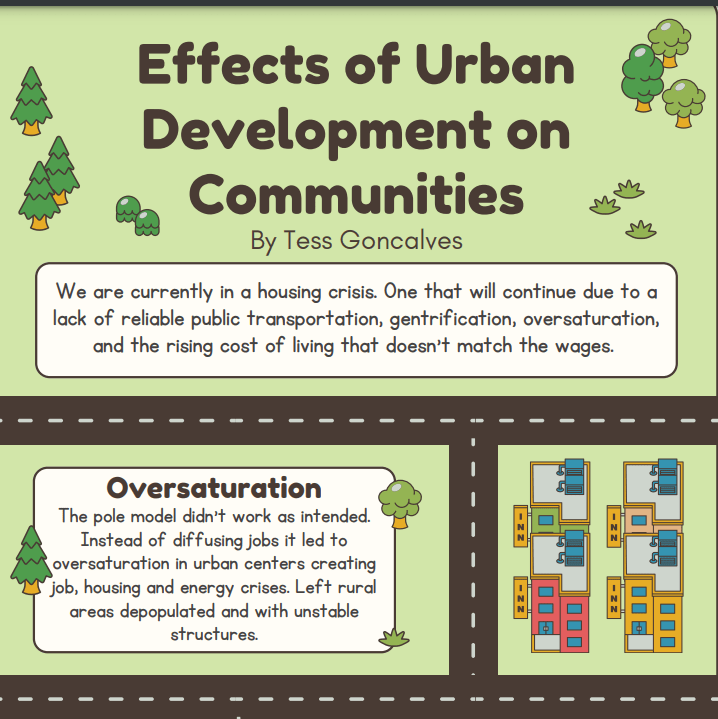
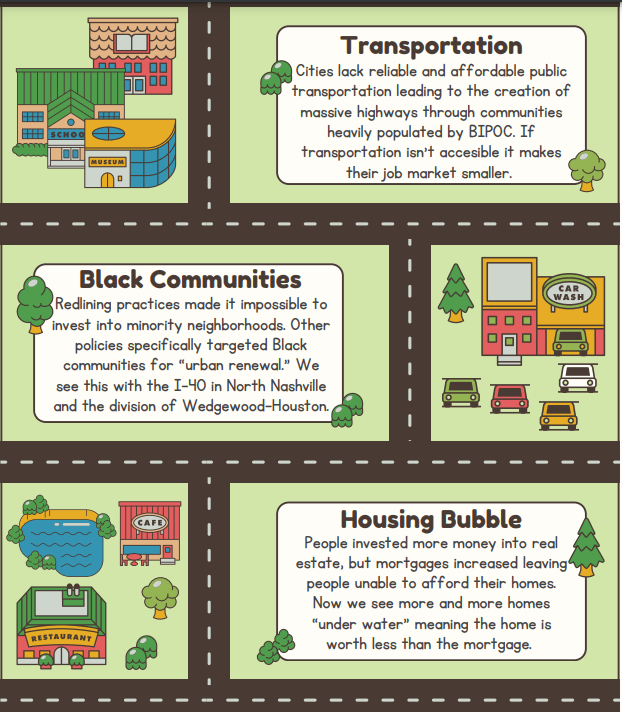
Toward the end of the semester is when we discuss policies related to housing and homelessness, including redlining, gentrification, vouchers, etc. In the fall semester, for the application part of this, I asked students to do a social media post or graphic that could be used to tell their friends/followers what they had learned. There were so many awesome responses to this mini-assignment, and I loved seeing how they were translating this information to others. We also had good discussion in the sense that doing these had raised additional questions for many of the students about things they didn’t fully understand, and also because they were getting questions and comments from their posts about them.
I asked one of my students for permission to share hers in a more public way, and she graciously agreed. This assignment was a good reminder for me that it is worth it to stress over the assignments, even the “little” ones, to make them as authentic and engaging as possible.
Last semester felt very long, as I discussed in my last post. I have friends who teach in various institutions across the country and so many of them expressed these same feelings about last semester. Whew.
One day in a particular class, when I could tell that people were stressed, I shifted gears early on into the class session. I crossed off the agenda items we had planned for the day and gave them some exercises/questions to do to help them think about their final paper. After that, we talked some about an upcoming holiday and listened to a bit of a podcast episode that had connections to the class.
I told them it is like preventative maintenance on your car, you have to be intentional to take care of it when it isn’t broken, so that you don’t find yourself in danger on the side of the road someday. I didn’t want them to be even more stressed in a few weeks when they realized this assignment was looming over them.
That little “re-set” in the second half of the semester didn’t work a miracle, but it did give us a chance to breathe a bit on a day we all seemed to need it. It was also a day that my students, most of whom I had not had in class before, deepened their trust in me because they could see I cared. That was a gentle but palpable shift.
As we finished last semester and then moved into the break, I continued to reflect on that day. For a social worker, I have always been not great at what we call “self-care”. Self-care has always seemed abstract to me. But in the past couple of years I have gotten better, finally, at what some people call “boring self-care” or what I referred to as “preventative maintenance” for my students. Taking care of things, and me, before breaking down is the very least I can do. (I still have room to grow.)
Hopefully you have some planned “preventative maintenance” days for yourself, and if not, I hope you consider it. Whether in your work or in your personal life, some space to breathe and the message to yourself that you are worth the rest is invaluable.
Woof. This is feeling like the longest semester ever. It has been feeling like that for several weeks now. A few weeks ago I broke a bone in my right foot. Boot life doesn’t lend itself well to campus life, even on a relatively compact campus. This past week I have had bronchitis…still have it. I don’t feel inspirational in any sense of the word. I barely even feel articulate enough to teach.
College students are struggling nationwide. I know this, and I want to be there for my students. This also hits closer to home these days as I have a high school senior who will be leaving for college next fall. How will she do? How can I support her?
It is hard to feel like I am complaining or whining about work when truly, it is a job I love. I have really amazing and supportive coworkers. I just can’t figure out why this semester seems so long and like an uphill slog because nothing is qualitatively different than other semesters with similar challenges (except for the age of my own child).
Some semesters just be like that, I guess. I have just never felt one so profoundly hard (and for that I am grateful). If you are feeling the same way, know that you are not alone. If you are having a great semester….send encouragement!
In social work education, we often have difficult conversations in the classroom as we grapple with teaching and learning about systemic racism, other forms of discrimination, and oppression. These discussions are relevant to the course and student learning, so I can’t “duck” them, but even though I have been in the classroom for 20 years, there are still times that facilitating a discussion on hard topics leaves me exhausted and questioning how it went.
Many times, I am the one who introduces the “hard topic”, either by the reading I assign or the discussion questions I open class with. However, sometimes students bring up the topics themselves, especially if the topics we are discussing in class relate to current issues evolving in the world around us. Either way, these discussions can be fruitful, and they can be exhausting.
When not done thoughtfully, these discussions can also be hurtful and exhausting, which is why so many of us dread them.
Many times over the years I have said “if I only taught math or science, I wouldn’t have to deal with having conversations like this.” That could be somewhat true, though I still think it is important to look at any discipline and see how inequities persist.
Given the current situation in the Middle East, I think it is likely that professors in all disciplines may be facing the need to figure out how to facilitate these difficult conversations, especially ones that may emerge organically (i.e. unplanned by the professor).
One of the biggest things I have learned over the years is that it is important to remember to tell students up front that I am not an expert on the difficult topic, and it is quite likely they could ask a question that needs some context for an answer that I just don’t have at the moment. I am comfortable with students hearing me say “I don’t know”.
Another thing I have worked at over the years is balancing participation and centering voices who might be closer to the problem (without “othering” them or singling them out). Asking students in advance if they would be willing to contribute to class discussion is useful, but in a scenario where discussion on a difficult topic emerges spontaneously, I do not specifically call on a student just because I think they have a connection to the issue.
Depending on the class topic and the learning goals, the students in the class, and whether or not the discussion was planned by me or was student initiated, I have used strategies that I have learned from a couple of different teaching centers, namely IU Bloomington and Vanderbilt. Here’ is IU’s page of resources for managing difficult conversations in the classroom and here is the one from Vanderbilt.
Just as I dropped my daughter off at dance class this morning, I heard the beginning of This American Life. I rarely feel compelled to listen to an entire podcast episode, (of any podcast), often listening a bit and then reading the transcript if I want to finish the story. It is more efficient and usually I am pressed for time. Today’s episode was a story I couldn’t stop hearing, or whatever the audio equivalent is to “I couldn’t put it down”. I kept the radio playing during a few errands and then when I got inside the dance studio I put in headphones and listened to the rest.
“The Call” is episode 809 of This American Life. It was a sobering, sometimes frightening, and very realistic portrayal of substance use, overdose, the challenges of treatment, and the all the ways drug use can devastate your life and well-being.
And also, at the end, it was a little bit hopeful.
I am going to think more about how I might use this is in a class. I could see it being used in policy class to help teach about programs of harm reduction. I could see it being used in courses teaching foundational content on substance use and practice in this field. I also think this is a podcast I would be careful about where and to whom I assigned it. I would definitely give some “trigger warnings” and give people some space and time to listen to it in a way that would not be triggering if they are personally close to these issues.
I don’t have personal connection in any close friend or family way to this issue, but I have many “looser” connections to it. Even with my degrees of separation, I was crying at several points during this episode at how raw and honest it was. So, do be mindful of how you use it in your work if you choose to. I think the power of the episode is worth the investment of time in figuring out how to use it well.