As 1/2 of “married filing jointly” household that just paid their tax bill the day before it was due, I am a little salty.
Hear me clearly: I would cheerfully pay my current taxes (and pay more) if we had less income and wealth inequality in our country, and if we were taking progressive measures to get there.
I would not be salty about taxes if we invested more in public education (not voucher scams), or if we had more efficient and robust health care outcomes. (We spend a lot of money on healthcare relative to our GDP, but our outcomes are depressing compared to other countries with similar economies.)
I also support continuation of Social Security payments in hopes that I get there some day. I support taking care of our veterans, and more.
I have been taught in multiple settings that a budget is a moral document; we fund what we value. I am not decrying the need to pay taxes. Render unto Caesar. But I would prefer for my renderings to go toward things that are in alignment with the collective good, with love for others and care for creation. We can operationalize that in many meaningful and important ways. What will it take to get us there?
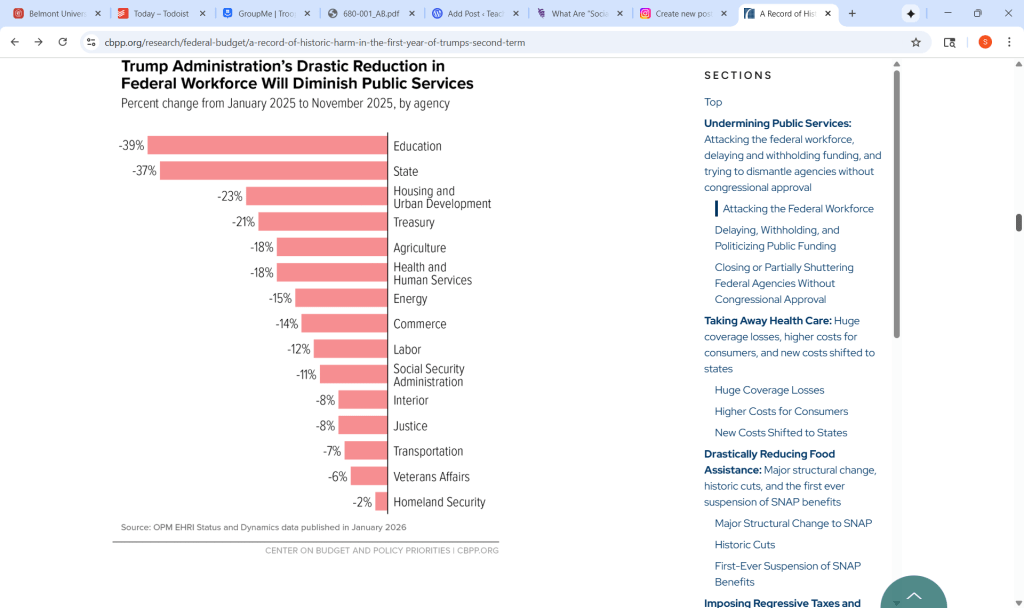
In looking at Center for Budget and Policy Priorities resources tonight, I took the screenshot below. Not only are we spending beyond our means, we are experiencing decimation of public services.
And with this pouring over the CBPP info, I broke my pledge to go to sleep at a decent hour. Alas. But as long as I am up, here are other sources useful for teaching students and others about federal spending: https://fiscaldata.treasury.gov/americas-finance-guide/federal-spending/ and, if you are wanting to track expenditures in as “real” a time frame as possible, this from The Hamilton Project is interesting: https://www.hamiltonproject.org/data/tracking-federal-expenditures-in-real-time/

