Late one night this past week several friends sent me links to the stories about Cesar Chavez, a primary figure of the United Farmworkers’ Movement. One of the classes I teach most every fall includes content on community organizing, and I always talk about the tactics and strategies he used in organizing farmworkers.
Thankfully, he has never been the only person I have talked about in this movement. I have always talked about Dolores Huerta as an equal force in organizing farmworkers, though she has remained less well known than Chavez. (Though last fall, at an event on campus celebrating Hispanic Heritage Month, I hosted a screening of the 2018 PBS documentary Dolores and most of the students who came were not familiar with either name.)
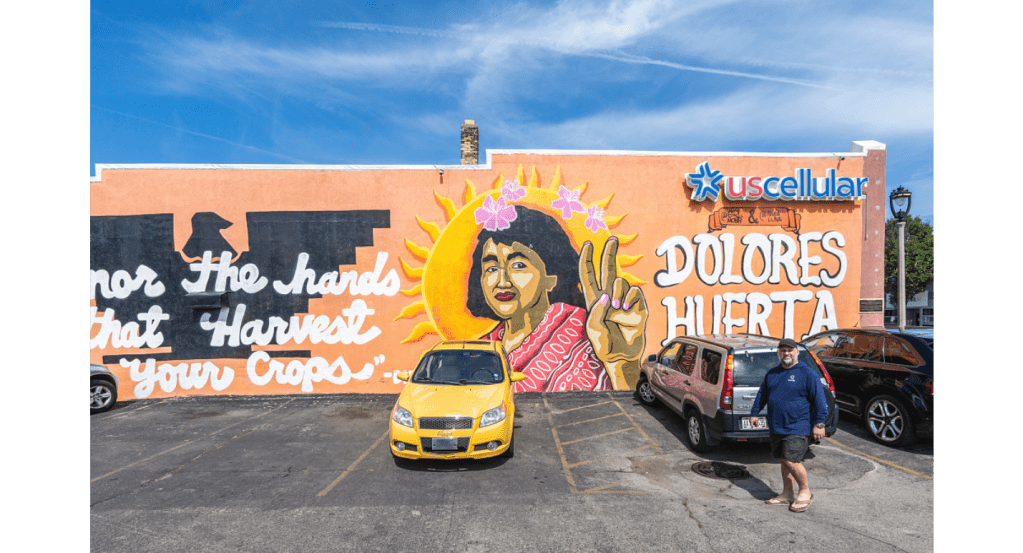
. United States Milwaukee Wisconsin, 2025. September 9. [Photograph] Retrieved from the Library of Congress, https://www.loc.gov/item/2026162509/.
Anyway…even though I have never focused only on Chavez, I have definitely held his work and his life—so I thought—in honor and esteem. The hunger strikes. The marches. The standoffs in the grape fields. His work was focused, honorable, and justice oriented. I held him in such esteem that I picked his stamps to be on my wedding invitations in 2003, for Heaven’s sake. I definitely would have called him a hero.
I never thought he was perfect. I definitely recognized his humanity. But I never thought he was a rapist and a pedophile. In thinking about this course that I teach coming around again in a few months, I will certainly make the movement the hero, as Huerta says in the NY Times article.
Thinking about Chavez’s “second death” (first, biological and second, moral/reputational), it makes me think of the broader issue of people in power (or even “spotlight”) using their power to sexually abuse others. Not every person in power abuses it in this way, but we have a long list of examples.
Jean Vanier, founder of the L’Arche Community for people with disabilities.
Church leaders. This may be the most easily hidden of all, since many faith communities don’t come into the spotlight.
Hollywood creatives, actors and producers.
So many political figures. So many.
The one whose name I can’t bring myself to type.
Honestly I could keep going but it is too depressing.
Clearly, there’s a broader issue to teach about here beyond community organizing strategies. How do we hold people in power accountable to just and right behavior? How do we hold systems accountable for censoring/stopping humans when they abuse/hurt others? What are the systemic/organizational traits that make it less likely a “leader” can abuse their power in this way?
I think this is one of the questions I will challenge my students with this fall as they prepare to work in non-profits, government systems, schools and more: How do you create a strong culture of safety in your workplace? What would you notice that it would tell you it is effective? What are the yellow or red flags that would tell you there are causes for concern?
 Teaching (toward) the Beloved Community